Sunday, December 10, 2017

It’s Time to Cap NCAA Coaching Salaries—How and Why

Supreme Court Justice Felix Frankfurter said “there is no greater inequality than the equal treatment of unequals.” 
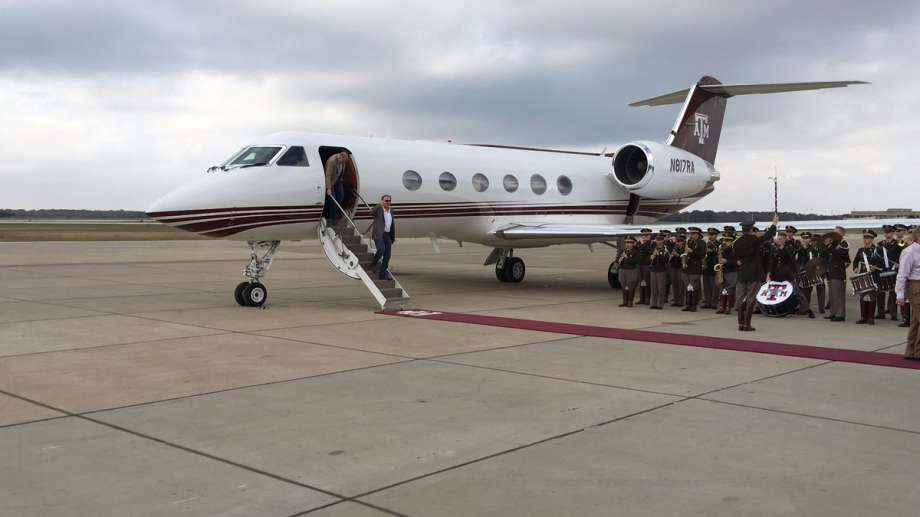
That’s NCAA Division football, in a nutshell. The schools adhere to a rule book as thick as the Bible, all to create rules of equal and fair play. But every year, the rich get richer—and they do it by breaking the bank to pay for football coaches. The latest example is Texas A&M’s hiring of Jimbo Fisher for $75 million (see his arrival above). By any standard—except NCAA Division I football— that is an obscene amount of money for a university employee.
Here at Illinois, our coach received a record contract, by university standards; yet in 2017, Lovie Smith’s contract ranks 39th in the nation for annual pay (paying $3 million this year).
There is a better way: The NCAA should set a salary cap on coaching salaries in football.
If that sounds like an unfair rigging of the market, it’s not. The NFL caps player salaries at approximately 50% of total league revenues. That’s spreading a lot of money over 53 players. It's legal because sports leagues are permitted by courts to impose anti-competitive rules in order to make their teams more balanced and competitive.
For the sake of simplicity, let’s say that the NCAA capped Division I at 10% of annual football revenues.
To put this in perspective, Texas A&M had the highest level of football revenue over a recent three year average-- $58 million per year. At Rank 25, UCLA averaged $38 million per year. 
Let’s just say that premiere football programs average about $40 million per year—and let’s set a 10% cap on head coach salaries, at $4 million per year.
The top 20 football salaries for 2017 paid over the $4 million threshold.
What would a salary cap achieve?
First, it would reorder the coaching salary market by constraining its out-of-control trajectory. We’re talking a hard cap in this proposal. Just as free agency in football—combined with a salary cap— leads to labor market mobility that often flows from championship teams to weaker teams, the best teams would retain some coaches but others would lose their talented employees.
Good coaches would be incentivized to explore schools with more cap space. Oklahoma’s Lincoln Riley would re-sign at $4 million (he’s at half that amount), or find a new school. A more likely scenario is that Larry Fedora—paid about $2.2 million at UNC—would move for a better contract.
Second, some college coaches would move to the NFL. If Nick Saban left for the NFL (again), every SEC football school would be thrilled. Currently, he's about $7 million above my cap-- so, he'd be movable. The point is that the SEC would become more competitive.
Third—and foremost— strained athletic department budgets would be shielded from a vicious cycle of spending on football head coaches. Money could be spread to fund more student scholarships. 
And that’s the point of the NCAA, isn’t it—to promote the interests of student athletes? But to judge from coaching salaries, this group might be better known as the NCCA-- the National Collegiate Coach’s Association.

Sunday, March 5, 2017

What Do You Think? Pros and Cons of the NBA Tracking a Player’s Bio-Data from Wearables?

I welcome readers to send thoughts on pros and cons of allowing teams to track bio-data from wearables. Send your ideas to m-leroy@illinois.edu.
If you use fitbit, meet its cousin on steroids, WHOOP. It is worn on the wrist but tracks data such as heart-rate. It has an accelerometer to detect when you are moving. The main thing it calculates is HRV.
A coaching guide says this: “HRV has been shown in numerous studies to positively correlate with athletic performance and training adaptation, and to negatively correlate with risk of overtraining and injuries. This document provides coaches with an overview of HRV with a focus on its utility as an athlete training tool.”
WHOOP can also be used to spot over-training—not just by measuring time spent in exertion, but by an HRV that correlates with an increased risk of injury. See http://whoop.com/validation/hrv-overview.pdf?_ga=1.183336355.48521612.1480105655.
The NBA’s collective bargaining agreement has new language on whether a team can collect data from WHOOP and similar wearables.
To summarize:
Art. XXII, Section 13 is specifically devoted to wearables.
A wearable is a device that is worn by a player that collects movement and biometric data.
Teams may ask players to wear these devises and allow teams to access data.
Players who agree to this request must be given the same data as the team.
Data can’t be used in negotiations.
The league and players union will develop more standards for the use of wearables.
***

Again, I welcome your thoughts!

Tuesday, November 22, 2016

Big Ten Expansion: Why Not UCLA, Cal?

TV controls college athletics to a harmful degree. Games are scheduled at inconvenient hours for student-athletes, fans, and university communities—but not for TV advertisers. With this essential logic in mind, I offer my quirky forecast for the Big Ten to add UCLA and Cal.
I’ll share my reasoning in a minute. First, here are my assumptions.
1.       Jim Delaney runs the conference, not university presidents.
2.       Jim Delaney covets TV markets.
3.       Jim Delaney—a product of my law school, UNC— understands the intrinsic value of outstanding public universities.
4.       Jim Delaney also understands the importance of cultural symmetry between schools as diverse as Rutgers and Nebraska, and their traditional Big Ten brethren.
5.       The Power 5 is a transition state that will become the Power 4 and eventually Power 3.

Here’s my reasoning for UCLA and Cal—not from my perspective, but my imagination of Jim Delaney’s perspective. Los Angeles (UCLA) is the #2 TV market in the U.S., and San Francisco (Cal) is the #6 TV market. With Rutgers, Delaney has a piece of the NY and Philly markets, rated #1 and #4. Chicago is #3. By acquiring these two schools, the Big Ten would have 5 out of 6 top TV markets (Dallas is #5).
Not only would these schools add tens of millions of TVs to the Big Ten gravy train—it would allow a TV window on Saturdays from noon Eastern time to midnight Pacific time. Can Delaney resist that?
Cal and UCLA are currently ranked #1 and #2 in the U.S. as public universities. Michigan is ranked #3. Illinois and Wisconsin are tied for #10, and so on.
What about travel and division imbalance? Those would be solvable in Delaney’s world. Move Illinois to the East. Add UCLA and Cal to the West. By present and historical measures, this Illini fan is sorry to say that this would dilute the East; adding UCLA and Cal would beef up the West (UCLA is having a down year, but compares to Nebraska). The result: more parity. 
Here is your lineup, reflecting current football standings:
East                                                                                        West
Michigan                                                                                Wisconsin
Penn State                                                                              Nebraska
OSU                                                                                       Iowa
Indiana                                                                                   Minnesota
Maryland                                                                               Northwestern
Illinois                                                                                   UCLA
Michigan State                                                                      Cal
Rutgers                                                                                  Purdue

Sunday, November 6, 2016

NCAA Transfer Restraints: Free Agency for College Players?

My brief (10-minute read, max) law review article, "NCAA Transfer Restraints: Free Agency for College Players," is available online here. (Photo is a former Illinois quarterback who left the program after a coaching change.)

Monday, October 31, 2016

Lovie, Lon Kruger and Nick Saban: The Importance of Hiring “Fit”

Adam Rittenberg of ESPN reports today, “Several industry sources say that Smith is miserable in Champaign. Yes, every 2-6 coach is miserable, but this situation is especially sour — and that the rebuilding job looks much greater than he anticipated. Could Lovie be one-and-done?”
For perspective, let’s recall Nick Saban’s failed experience as a head coach of the Miami Dolphins. The logic behind his hiring was (a) NFL rosters were becoming younger, (b) a college coach would understand younger players, and (c) Saban won a national title at LSU in 2003.
Saban was a head coach at Toledo (1990), and Michigan State (1995-1999) and LSU (2000-2004) before he had a HC job in the NFL. He wasn’t a bad coach but he was the wrong fit for the NFL. As soon as he returned to Alabama, his greatness as a coach became immediately evident.
Lon Kruger coached at a very successful level at Kansas State, Florida, and Illinois before he left NCAA coaching for the HC job of the Atlanta Hawks. He bombed there—but he was hired because the league was getting younger, and the Hawks assumed a college coach would relate to a younger team.
Like Saban, as an NCAA “retread” he revitalized UNLV, took a better job at Oklahoma, and took his team to the NCAA Final Four last year.
Lovie Smith has a similar pattern. He was never more than an assistant coach in college, and left NCAA football in 1996. Twenty years later, he returned to Illinois as a head coach.

There is a reason that labor markets for head coaches in professional leagues and the NCAA rarely overlap—the games are played very differently; a unionized employment relationship for players is very different from an NCAA-regulated relationship that coaches manage with “student-athletes”; and the cultures of pro leagues and NCAA teams are worlds apart. (Consider Chip Kelly in this context, too.)
Jim Harbaugh, you say, as a counter-example?
Let’s not forget that Harbaugh is the son of a “lifer” NCAA football coach, Jack Harbaugh. Quoting Jim Harbaugh’s wiki bio, “During Harbaugh's childhood, the family moved frequently, as his father held assistant coaching positions at Morehead State (1967), Bowling Green (1967–1970), Iowa (1971–1973), Michigan (1973–1979), Stanford (1980–1981), and Western Michigan (1982–1986).” Later, Harbaugh had a successful 13-year career as an NFL quarterback with the Bears, Colts and Chargers. No wonder he is a rare example of someone who understands both worlds of NCAA and NFL football.

Whether hiring is for Division I, NFL and NBA coaches, or any other setting what matters is getting the right fit between the job candidate and the needs of the organization. A hiring process that ignores the fit issues often yields disappointing results.

Tuesday, October 25, 2016

Big Money in College Sports: How Is It Spent?

The answer to this question was reported in Inside Higher Ed yesterday. The Knight Commission, a body that provides oversight of NCAA activities, put forth this chart (click to enlarge, see bottom chart):

Illinois is barely in FBS Quartile I. This means (roughly speaking) that 34% of revenues are spent on salaries of coaches and staff. Facilities get 21% of the pie, and athletic aid to student-athletes receives 10%.

How much does the school receive? About 2%, assuming that Illinois is typical.

This imbalance will be harder to maintain as state universities, such as the University of Illinois, cut and reorganize academic units while the athletic side spends lavishly on salaries and facilities.

Wednesday, October 19, 2016

How College Athletics Could Save the Nation

Suppose current polls hold up, and Hillary Clinton wins by a near-landslide. Further suppose that after the election, Donald Trump refuses to concede and doubles down on his narrative that the voting booths are rigged, thus making Clinton an illegitimate president-elect.
Would Alabama secede from the nation?
Hold that thought for a moment. Alabama has the #1 college football team in the nation—not in Alabama, but the nation. How long could a secession conversation go on without the NCAA weighing in by stating that it is an association of American universities? If a state secedes, it’s no longer in America; and its state university cannot compete in college athletics.
If you’re still reading, we can agree that this is totally absurd … until we think about the on-going transgender-bathroom controversy in North Carolina. Now seriously, a year ago could we imagine that a North Carolina law would bar transgender choice of a bathroom, and as a consequence, the NBA would drop Charlotte for the All-Star game, and the NCAA and the ACC would drop North Carolina venues for championships?
A year ago, I would have rated that possibility in realm of the absurdly improbable.

A lot of unpredictable events in politics and sports have occurred in a short time. Perhaps we’re on a path where people will need to choose between passion for a college championship and remaining in the United States.

Saturday, August 27, 2016

Union Rule: Show Up for Work, or No More Work


Do unions protect lazy, irresponsible workers? The union for theater stage workers operates a hiring hall for productions and trade shows. The union has this rule: If it’s your turn to work, and you are a no-show twice, the union fines you $150 fine. You must pay up to be put back on the list. A third no-show gets you a $200 fine—and after that, you’re permanently kicked off the union’s work list.
A member sued the union, claiming the policy violated its duty of fair representation.
The NLRB ruled in favor of the union, saying that it wasn’t unreasonable for the union to craft such a policy to make sure the workers it refers show up to their jobs. The NLRN cited the union's interest in having a good reputation for supplying reliable labor to employers. The case is International Alliance of Theatrical Stage Employees, Moving Picture Technicians, Artists and Allied Crafts of the United States, Its Territories and Canada, case number 27-CB-093060, before the National Labor Relations Board.

Saturday, August 20, 2016

Dead Man Suing NHL


Lawsuits in behalf of dead people are common. Thus, it is somewhat puzzling that the National Hockey League is opposing the addition to the plaintiff class of Larry Zeidel, who was diagnosed with chronic traumatic encephalopathy (CTE) after he died. His addition to the lawsuit would serve to represent a class of players diagnosed with brain diseases.
The NHL is arguing that former players do not have good cause to their dead colleague, who died in 2014, because the players could have known as long as 18 months ago that he had been diagnosed with CTE.

Zeidel’s diagnosis could not be confirmed until after he died and his brain was autopsied.

Wednesday, July 13, 2016

Justice Ginsburg’s Next Controversy Is Days Away… Ruling on Pro-Trump, Tom Brady’s Appeal


If Tom Brady were Joe Lunchbox, his appeal of an arbitration award would not have won him personal face-time with Judge Richard Berman, who oafishly interfered with the NFL-NFLPA process for hearing grievances. But Judge Berman needed his 15 minutes of fame, which he ingloriously earned—only to be reversed with klieg lights blaring from the Second Circuit.

Now, the Tom Brady and Ruth Bader Ginsburg circuses are on collision course. Brady, a polarizing cheater, is pro-Trump; Ginsburg, a polarizing Supreme Court Justice is anti-Trump. And wouldn’t you know it—she’s assigned to hear emergency appeals from the Second Circuit.

So, one can now expect that Brady’s lawyers—who have endlessly tried his case in the media, to fairly good effect— have a new Trump-card to play—recusal of the biased Justice.


At the end of this wasteful scrum, look for two losers to increase their losses by August: Tom Brady and Ruth Bader Ginsburg. Sad to see such talent wasted on their egos.


Monday, June 6, 2016

Reporters Who Goad People to Defame? Recalling Muhammad Ali’s Experience before a Labor Arbitrator

Howard Cosell (ABC TV) contacted Muhammad Ali for an exclusive interview after the Ali-Wepner fight. In classic form, Cosell goaded and prodded Ali to fulminate. Ali obliged with a torrent of controversial criticism against the referee. For the interview, Ali was paid $5,000 and was a member of AFTRA, a union that represents TV and radio performers and employees.

The referee sued Ali for defamation. Ali’s attorney’s fees soared to $193,353. He demanded arbitration seeking payment of his fees from ABC. The arbitrator ruled for Ali, in these terms:

“In the instant case, I note Mr. Cosell has publicly stated that his relationships on air with Ali were consistently designed to ‘challenge him’ so that Ali would ‘bang back.’”


One lesson that is relevant today: If a news reporter goads a public figure to make defamatory comments during a paid interview, the reporter and broadcasting company share responsibility for the harmful message.

Definition of Ridiculous: 21 Scientists File Brief in Tom Brady’s Deflategate Arbitration


Should we have a national referendum on Tom Brady’s four game suspension for participating in a scheme to deflate the Patriots' game balls? Now comes word that 21 physicists and engineers have taken time from their professional pursuits to write a brief to the Second Circuit Court of Appeals that questions the science behind an engineering firm’s analysis of the actual game balls.

The gist is reported in Law 360: “The professors said that NFL game balls frequently lose pressure because of the temperature difference between the locker room, where they’re filled, and the playing field, and that the league is aware of this phenomenon. They said Goodell’s data accounted for a natural pressure loss, and then assumed Brady was responsible for the balls losing pressure beyond that. But, he never defined how much air Brady is allegedly responsible for releasing, and an NFL report suggested it could have been as small as 0.14 pound per square inch gauge, which the professors said was too small to infer any tampering.

“To us as scientists, an increment of pressure loss as tiny as 0.14 psig is too small to constitute proof of tampering. It is well within any reasonable margin of error, based on our assessment of the league’s measurements,” the proposed brief said. “The very existence of any increment, moreover, was divined through assumption. The data necessary for any bona fide scientific analysis was never collected.”

I’m not a scientist but the facts show that EVERY game ball on the Indianapolis Colts' side of the field were within the NFL’s legal parameters, and EVERY game ball on the New England Patriots’ side of the field was below the NFL’s legal parameters. To my fellow professors, please apply your talents to more pressing problems where your expertise can be more useful—and keep out of labor disputes, please.


Tuesday, May 3, 2016

Is Stanford A Useful Comparison for Illinois? The Boneyard!

Having been duly questioned about my last post, I offer a different comparison. As reported by the Stanford Athletic Department (read here), “Stanford’s mascot and nickname have a history that dates back to the University’s founding in 1891. While the Cardinal has always been one of the school’s official colors, the nickname has gone through a series of changes, student votes, controversy and confusion.” Okay, that’s familiar.

“Stanford officially adopted the Indian nickname on Nov. 25, 1930 after a unanimous vote by the Executive Committee for the Associated Students. The Indian had long been considered the symbol of Stanford before the official vote, although its origins are only speculation.” Okay, that’s about the time the Chief became our school’s cherished symbol.

“The Indian symbol was eventually dropped in 1972 following meetings between Stanford native American students and President Richard Lyman. The 55 students, supported by the other 358 American Indians enrolled in California colleges, felt the mascot was an insult to their culture and heritage. As a result of these talks and the ensuing publicity, the Stanford Student Senate voted 18-4 to drop the Indian symbol, and Lyman agreed.” Okay, that sounds like the news story yesterday and today.

“In 1978, another group comprised of 225 varsity athletes from 18 teams, started a petition for the mascot to be the griffin – a mythological animal with the body and hind legs of a lion and head and wings of an eagle. The University moved two griffin statues from the Children’s Hospital to a grassy area between Encina Gym and Angel Field. The campaign for the Griffins failed.” Okay, that sounds like a cautionary tale for Illinois.

“The Mascot: There is no official mascot at Stanford University. The "Tree," which is a member of the Stanford Band, is representative of El Palo Alto, the Redwood tree which is the logo of the city of Palo Alto. Since Stanford University and Palo Alto are almost inextricably intertwined in interests and location, it is a natural outgrowth of this relationship. The tree still exists and stands by the railroad bridge beside San Francisquito Creek – it is the site where early explorers first camped when settling the area.” Okay, maybe we’ll be the BONEYARD.

Who Changes Their Team Name? Legendary Football Teams

As Illini Nation divides itself over a new mascot, it is worthwhile to consider iconic NFL teams. The Chicago Bears began in 1919 as the Decatur Staleys, so-named for the A. E. Staley food starch company of Decatur, Illinois. Also formed in 1919, the Green Bay Packers had their uniforms purchased by the Indian Packing Company with the understanding that the team be named for its sponsor. Interesting to note, they dropped their Indian identity long ago without losing their fan base. The Pittsburgh football franchise, originally named the Pirates, was later renamed the Steelers out of respect for the city’s leading industry. The Bears. The Packers. The Steelers. All began with different names and identities. If they survived and flourished, chances are that the University of Illinois will make a successful transition, too.

Tuesday, April 26, 2016

Appeals Court Examines Brady's Balls


The Second Circuit’s order to confirm Roger Goodell’s four game suspension of Tom Brady concludes that the players association agreed to an unusually broad arbitration clause, and the Commissioner, acting as a duly authorized arbitrator, committed no procedural errors.
Perhaps the most interesting part of yesterday’s decision for non-lawyers is the lengthy excerpt of how the Patriots under-inflated their game balls.
Here is a pertinent quote:
During the second quarter, Colts linebacker D'Qwell Jackson intercepted a pass thrown by Brady and took the ball to the sideline, suspecting it might be inflated below the allowed minimum pressure of 12.5 pounds per square inch. After confirming that the ball was underinflated, Colts personnel informed League officials, who decided to test all of the game balls at halftime. Eleven other Patriots balls and four Colts balls were tested using two air gauges, one of which had been used before the game to ensure that the balls were inflated within the permissible range of 12.5 to 13.5 psi. While each of the four Colts balls tested within the permissible range on at least one of the gauges, all eleven of the Patriots balls measured below 12.5 psi on both.
On January 23, the National Football League announced that it had retained Theodore V. Wells, Jr., Esq., and the law firm of Paul, Weiss, Rifkind, Wharton & Garrison to conduct an independent investigation into whether there had been improper ball tampering before or during the game. That investigation culminated in a 139–page report released on May 6, which concluded that it was “more probable than not” that two Patriots equipment officials—Jim McNally and John Jastremski—had “participated in a deliberate effort to release air from Patriots game balls after the balls were examined by the referee.” Specifically, the Report found that McNally had removed the game balls from the Officials Locker Room shortly before the game, in violation of standard protocol, and taken them to a single-toilet bathroom, where he locked the door and used a needle to deflate the Patriots footballs before bringing them to the playing field.
In addition to videotape evidence and witness interviews, the investigation team examined text messages exchanged between McNally and Jastremski in the months leading up to the AFC Championship Game. In the messages, the two discussed Brady's stated preference for less-inflated footballs. McNally also referred to himself as “the deflator” and quipped that he was “not going to espn ... yet,” and Jastremski agreed to provide McNally with a “needle” in exchange for “cash,” “newkicks,” and memorabilia autographed by Brady. The Report also relied on a scientific study conducted by Exponent, an engineering and scientific consulting firm, which found that the underinflation could not “be explained completely by basic scientific principles, such as the Ideal Gas Law,” particularly since the average pressure of the Patriots balls was significantly lower than that of the Colts balls.. Exponent further concluded that a reasonably experienced individual could deflate thirteen footballs using a needle in well under the amount of time that McNally was in the bathroom.

The investigation also examined Brady's potential role in the deflation scheme. Although the evidence of his involvement was “less direct” than that of McNally's or Jastremski's, the Wells Report concluded that it was “more probable than not” that Brady had been “at least generally aware” of McNally and Jastremski's actions, and that it was “unlikely that an equipment assistant and a locker room attendant would deflate game balls without Brady's” “knowledge,” “approval,” “awareness,” and “consent.” Among other things, the Report cited a text message exchange between McNally and Jastremski in which McNally complained about Brady and threatened to overinflate the game balls, and Jastremski replied that he had “[t]alked to [Tom] last night” and “[Tom] actually brought you up and said you must have a lot of stress trying to get them done.” The investigators also observed that Brady was a “constant reference point” in McNally and Jastremski's discussions about the scheme, had publicly stated his preference for less-inflated footballs in the past, and had been “personally involved in [a] 2006 rule change that allowed visiting teams to prepare game balls in accordance with the preferences of their quarterbacks.” 

Saturday, April 16, 2016

What College ADs Can Learn from Data Mining

A recent Wall Street Journal article features a Credit Suisse study that measures the usefulness of three common financial stats– sales growth, net income growth, and gross profitability— and compares these standard business metrics to three baseball metrics for hitting (batting average, the strikeout rate, and the somewhat more esoteric “on-base percentage plus slugging percentage”).

The finding is a bit shocking: the three common financial stats are far less helpful than some of those used in baseball.

What makes a statistic useful? Its persistence and predictive value. As summarized by WSJ, “a statistic is persistent if it is correlated with what happened in the past. It’s predictive if, as the word suggests, the stat is successful at predicting outcomes.”

Turning to college football, here are the biggest buyouts of college football coaches: Charlie Weis, Notre Dame ($18.9 million not to coach); Bo Pelini Nebraska ($7.9 million not to coach); Gene Chizek Auburn ($7.5 million not to coach); Will Muschamp Florida ($6.3 million not to coach); Charlie Weis Kansas ($5.625 million) (double dipper); and Jeff Tedford Cal ($5.5 million). The list of million-dollar buyouts goes on, but the point is that ADs probably make hiring decisions based on short-term, shallow, and non-empirical “hunches” about coaching hires. Common approaches, with mixed results: NFL to college; OC/DC at elite school; MAC champ to Big Ten.

But what if someone studied in-depth the data that has the most persistent and predictive value for successful college coaches, like Credit Suisse? You might measure entirely different things, such Nick Saban’s obsessive detail to focusing short-term on executing minute goals that stack up to big success. Quoting Saban: "Don't think about winning the SEC Championship. Don't think about the national championship. Think about what you needed to do in this drill, on this play, in this moment. That's the process: Let's think about what we can do today, the task at hand."

Thursday, April 14, 2016

We Will Win: College Football and State Politics


After University of Georgia’s new football coach, Kirby Smart, was seen flying around in a helicopter and private jet to recruit star football players, the Atlanta Journal-Constitution used the FOIA law to investigate. The result? After some unflattering news stories, Georgia passed a FOIA law this month that allows Georgia’s athletic department to wait 90 days before responding to a records request from news agencies.

Before the law was enacted last week, AJC reported that the new coach and his staff produced 25 invoices totaling $558,741 in two months. Several invoices reflected charges of $20,000 or more for private jets, with a high of $45,306 on December 11th.

Georgia football isn’t alone in trying to hide information from the public. ESPN has used Indiana’s open records law to compel the Notre Dame police department to hand over documents relating to the alleged arrests of football players. The network contends that Notre Dame’s police department is a public entity because it is authorized by the state to enforce all Indiana laws. In mid-March, a state appeals court ruled in favor of ESPN.

But that might be irrelevant because Notre Dame friends in the legislature passed a FOIA exception just for this case. This bill is currently on the governor’s desk. It would classify private university police departments as public agencies, but would also exempt certain records from being released to the public.

To put this in context, consider Prof. Ryan Brewer’s (Indiana University, finance department) rankings of D-I football programs by market valuations used for professional football teams. Notre Dame ranked 2nd in the nation, valued at $811.5 million (behind Texas at $875 million). Georgia ranked 8th at $581.8 million. Illinois was a distant 55th ($94.5 million).

For years, it’s been true that college football is more a business than a game. College football at Georgia and Notre Dame show that these big businesses are also powerful interest groups. Georgia governor’s spokesperson admitted as much when she said, “This is an economic development bill, and the governor supported the inclusion of the language regarding athletics. It simply levels the playing field with other states that also have strong athletic programs like Georgia.”

Monday, March 21, 2016

Homage to Franklin Field (UPenn)

Visited the site of a great controversy in NCAA history, the Penn football stadium. NCAA rules limited TV slots for power football programs, such as Oklahoma and Georgia, to give TV time to schools such as Penn. This quaint idea spurred Oklahoma and Georgia, and others to form their own TV alliance. The NCAA retaliated by threatening sanctions against these schools in basketball and other sports. Oklahoma and sued under the Sherman Antitrust Act ... after which cooler heads prevailed. This paved the way for power schools to get much greater market exposure, and eventually, the Big Ten became the first to do its own TV network. Penn Stadium is beautiful and was the site of a women's lacrosse practice as we visited.  

Thursday, March 17, 2016

Illinois vs. Notre Dame in St. Pat’s Midwest Shame Bracket


The Fighting Illini and Fighting Irish are playing into overtime this St. Patrick’s Day to see which team advances  in the Midwest Shame bracket.

The Illini took an early lead today when Kendrick Nunn became the third Illinois player in the past month to be arrested for a violent crime (this, for domestic assault). A fourth player in the past year was dismissed due to his second brush with the law.

The Fighting Irish charged back in a battle to keep ESPN from having access under public records to Notre Dame police arrests of athletes (especially, football players). An Indiana appeals court, over the objections of Notre Dame officials, ruled that the private university’s police force is a public entity when records involve enforcement of state (i.e., public ) laws. But Notre Dame will appeal to the state supreme court; and separately, Notre Dame has successfully lobbied for a bill that will basically repeal this ruling. 

Both schools have “Fighting” in their names, meaning that these great universities will not be charged with deceptive marketing.

Tuesday, March 15, 2016

News-Gazette Liable for False Light? The Case of Jaylon Tate


When Illinois basketball player, Jaylon Tate, was arrested over the weekend for domestic assault, our local newspaper, the News-Gazette, made it a headline story in its online edition, complete with mugshots of Tate. By Monday, Tate's attorney, complained about the rush-to-publicity (and judgment), though he didn't specifically reference the paper. 

If Tate has been wrongly accused, does he have a tort claim for damages against the newspaper? Without question, the paper was doing its duty in reporting a matter of keen public interest. But did it need to run mugshots of Tate, in images that cannot be reversed or deleted?

Illinois recognizes the tort of "false light." In general, false light occurs when one person publishes information which places another person in a false light with reckless disregard or malice. There was no malice here; but what about reckless disregard? Here, it is important to note that most employers do background checks for criminal convictions-- and some do this for arrests, even though that violates discrimination laws. Google Jaylon Tate in a year or two, and odds are you will find his mug shot in the News-Gazette. From a lawyer's perspective, the question is whether Tate's claim would survive a motion to dismiss, thus making it possible to go to a jury trial. Here's hoping that the News-Gazette apologizes publicly to Tate and learns that a headline without a mugshot would suffice for informing the public. And note, when a newspaper runs a story that incorrectly portrays an African-American male as a criminal, the damage is especially significant.